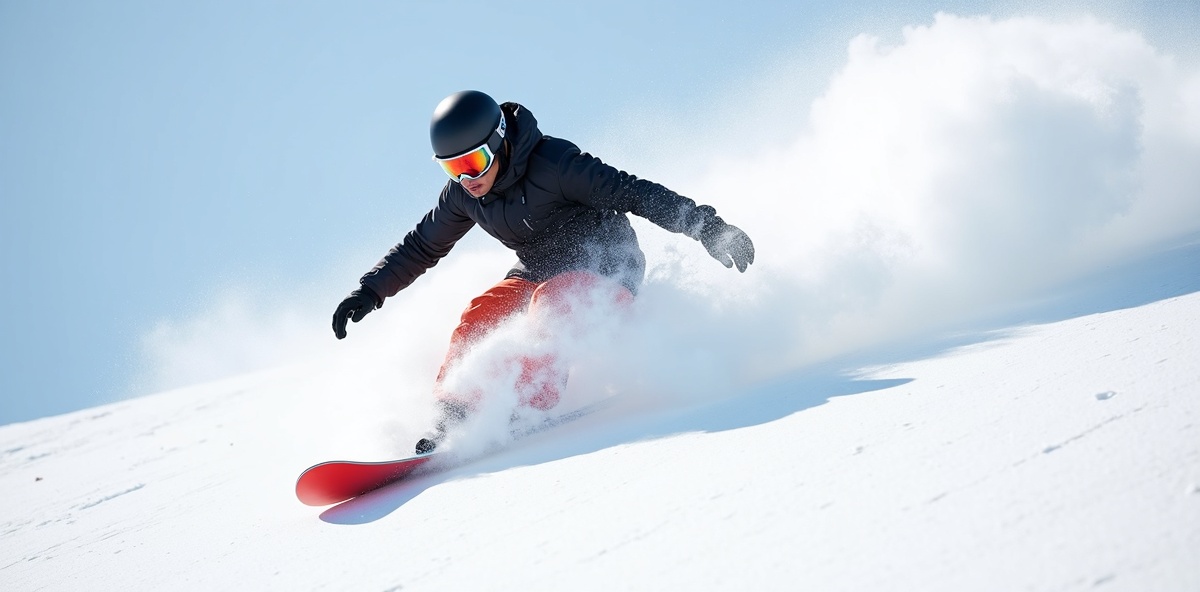
Master Carving: Complete Guide to Perfect Turns in 2026
Learn the biomechanics and techniques used by pro riders to carve like a champion. From edge control to body positioning, master every aspect of carving.
Carving is the purest expression of snowboarding on groomed snow. When done right, you're not skidding or sliding — you're drawing a clean arc into the snow with just the edge of your board, like a razor on ice. It's fast, efficient, and incredibly satisfying.
Understanding Edge Angles
The foundation of carving is edge angle — the degree to which your board tilts onto its edge relative to the snow. A 0° angle is flat. A 90° angle is standing the board on edge. Great carvers typically work between 45° and 70° depending on speed and slope gradient.
Start practicing edge angles on flat ground. Stand in your bindings and practice tipping the board onto the toeside and heelside edges with just your ankles — before you add any slope or momentum. This builds the neural pathways needed on the hill.
Body Positioning: The Carving Stack
For a carved heelside turn, think of 'sitting into a chair' — hips drop, knees bend, and the upper body inclines slightly uphill. For a toeside turn, drive the knees toward the snow, lean your shins into the front tongue of the boots, and let the hips come toward the hill.
- Heelside: hips low and behind, shoulders parallel to board
- Toeside: knees pressing toward snow, shins forward, hips toward hill
- Both turns: keep weight centered over the board — never on the back foot
- Head up: look where you are going, not at your board
- Quiet upper body: most movement comes from the hips down
Initiation: Starting the Turn
The most common mistake in carving is initiating the turn with the upper body — twisting the shoulders to start the arc. Instead, initiate with a subtle ankle tilt, shifting weight from one edge to the other. Think of it as 'steering with your feet, not your shoulders.'
The Pressure Transfer Sequence
- 1Release the current edge by flattening the board (very brief neutral phase)
- 2Tip the new edge by rolling ankles in the new direction
- 3Build pressure by bending the front knee and driving weight into the board
- 4Extend through the turn to complete the arc and generate speed for the next turn
- 5Repeat — rhythm and timing are everything
Common Mistakes and Fixes
- Skidded turns (not true carving): slow down, use a flatter slope, focus on ankle tilt first
- Falling onto back foot: consciously drive front knee over front foot at turn initiation
- Stiff upper body: relax shoulders, breathe, and let the hips do the work
- Rushing transitions: pause briefly at the fall line before committing to the next edge
- Too much boot flex: make sure bindings are tight — sloppy boots kill edge feel
"Carving is not something you do to your snowboard. It is something your snowboard does when you get out of the way and give it the right edge angle." — Jake Morrison
Jake Morrison
Jake Morrison is a CASI Level 4 snowboard instructor and former competitive halfpipe rider. He has coached national team athletes and runs snowboard clinics at Whistler Blackcomb every winter.